
DEP received US Patent for its CAD-Morpher Technology
DEP is pleased to announce that we have been awarded the U.S. Patent No. 10,062,146 on 28th August 2018 for our unique CAD Morpher technology. The CAD-Morpher is an innovative concept that allows users to morph existing CAD data directly to new target shapes without much time & effort from design engineers.
PATENT TITLE: SYSTEM AND METHOD FOR MORPHING A CAD DESIGN
Brief Note: The CAD-Morpher is a transformational morphing feature from DEP which allows users and provides them the ability to efficiently modify an existing full vehicle CAD data (Body structures, Powertrain and Chassis parts) directly to new shapes. For example, the complete BIW CAD data of an existing production vehicle can be made to morph and fit a new vehicle’s styling data and/or proportions.
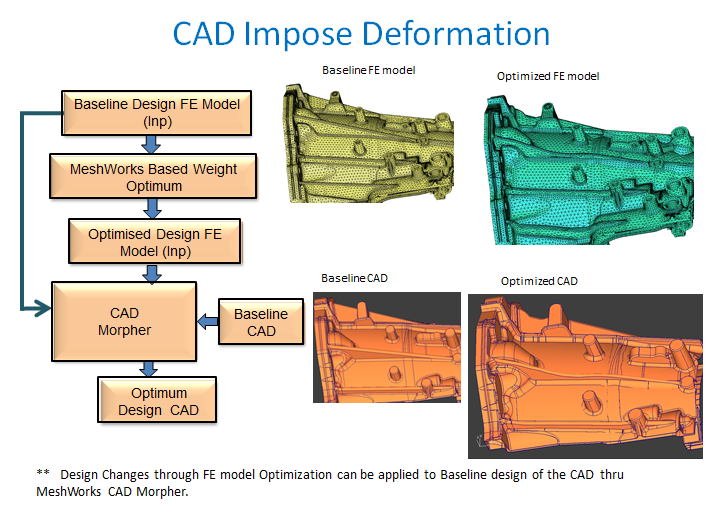
Today’s automotive industry scenario demands for more optimized and comfort rich models to be made out their garage in less time. More designs have to be explored and each design have to full fill certain constraints before moving to the production desk. With the above mentioned critical requirements every manufacturer is on the look-out for a best tool that makes both ends meet. CAD Morpher comes as a saviour for the day with the ground-breaking concept of building CAD models faster than ever imagined before time duration. Its ability to handle both CAD and CAE models makes it a perfect link between CAE and Design teams. Optimized Finite Element and CFD data can be communicated to the design department directly as morphed CAD data which is extremely useful in creating multiple designs with various specs and constraints in lesser time.
Innovative Features of CAD Morpher:
CAD Morpher enables early availability of Reference CAD during early engineering stage unlike the traditional CAD process which is a reactive process and lags behind the development cycle for a Product. Some of the notable features of DEP CAD Morpher are:
- CAD Morpher has the capability of morphing CAD data in a wide variety of scenarios very easily, efficiently and rapidly.
- It delivers optimized and balanced products faster to market.
- More importantly CAD morphing can be carried out at all the different stages of vehicle development:
- Early concept stage: Old vehicle CAD data can be fitted to target new styling data and vehicle proportions
- Vehicle architecture development: Existing BIW CAD data can be automatically updated to fit new sections as determined by architecture team
- Vehicle optimization: Existing vehicle CAD data can be updated to match optimized results obtained by the CAE team
Major Application Area of CAD Morpher:
- Packaging:
- Human factors
- Criteria evaluation
- Vision Study
- Typical Section Development & start data for detailed CAD
- Early Formability & weld access study
- Zone and Limits compliance
- Evaluate Styling theme impact
Advantage of CAD Morpher:
With this ‘game-changing’ CAD Morpher technology of DEP, customers can build models up to 10 times faster than the conventional methods. Ultimately CAD Morpher is promising a drastic reduction in the product development cycle time.
With a CAD Morpher enabled Product Development, customers achieve:
- Rapidly Develop new vehicle derivative of existing platform
- Maximize carry over part and process
- Confirm performance compliance at design stage
- Provide complete new CAD reference data
- All in Record time